
Letter
from Charles Kaighin (10300)
to
his nephew Charles Kaighin (9400)
See transcription at the bottom
of the page
To download high resolution
images of this letter click here
Special thanks to Diana Bulls
of the Reedley (CA) Historical Society for unearthing this treasure
Editor’s clarifications in brackets [].
|
This letter was written in 1841 by my third-great-grandfather,
Charles Kaighin, and addressed to his nephew, also named Charles Kaighin, in
New York City. The younger Charles was the son of the elder Charles’s brother
John and John’s wife, Eleanor Cannell. Around 1826, John and Eleanor
emigrated from the Isle of Man with eight of their thirteen children, whose
ages ranged from one to twenty-five. The family settled at 653 Water Street,
in the area now known as Lower Manhattan. The financial means by which John supported so substantial
a migration remain uncertain. Passage for the family would have cost
approximately £50 to £70 in 1824, the equivalent of
roughly $10,000 in 2026. More significant than the expense of the journey,
however, was the property John left behind. He had been the tenant landholder
of the quarterland farm of Ballaquine in Kirk German parish and of the
adjoining farm of Middle Kerrowglass in Kirk Michael. Before emigrating, he
settled both holdings upon his eldest son, John, who remained on the Isle of
Man. The letter’s recipient lived near the family’s original
Water Street residence. The 1840–41 New York City directory identifies him as
a ship’s carpenter residing at 429 Cherry Street; by the time the letter
arrived in late 1841, he was living at 662 Cherry Street. He was married and
had a son, Charles Henry, born about 1835. Charles died on 25 July 1842,
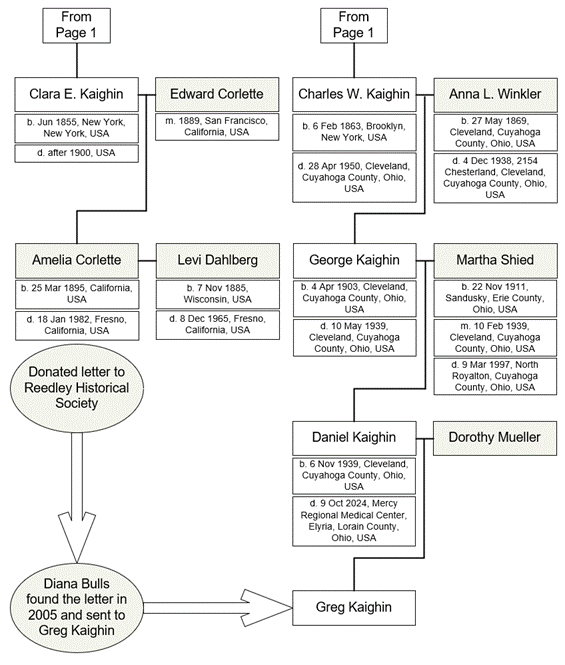
approximately nine months after receiving the letter. The letter subsequently passed to Charles’s youngest
brother, Thomas. Thomas married Mary Dennis and, in the 1890s, moved with her
and their surviving children to the San Francisco area. Among them was their
daughter Clara, who later married Manxman Edward Corlett. Clara and Edward’s
daughter Amelia eventually settled in Reedley, California. Through this line
of descent, the letter reached the Reedley Historical Society, later known as
the Reedley Historical Museum. In 2005, museum curator Diana Bulls discovered the letter
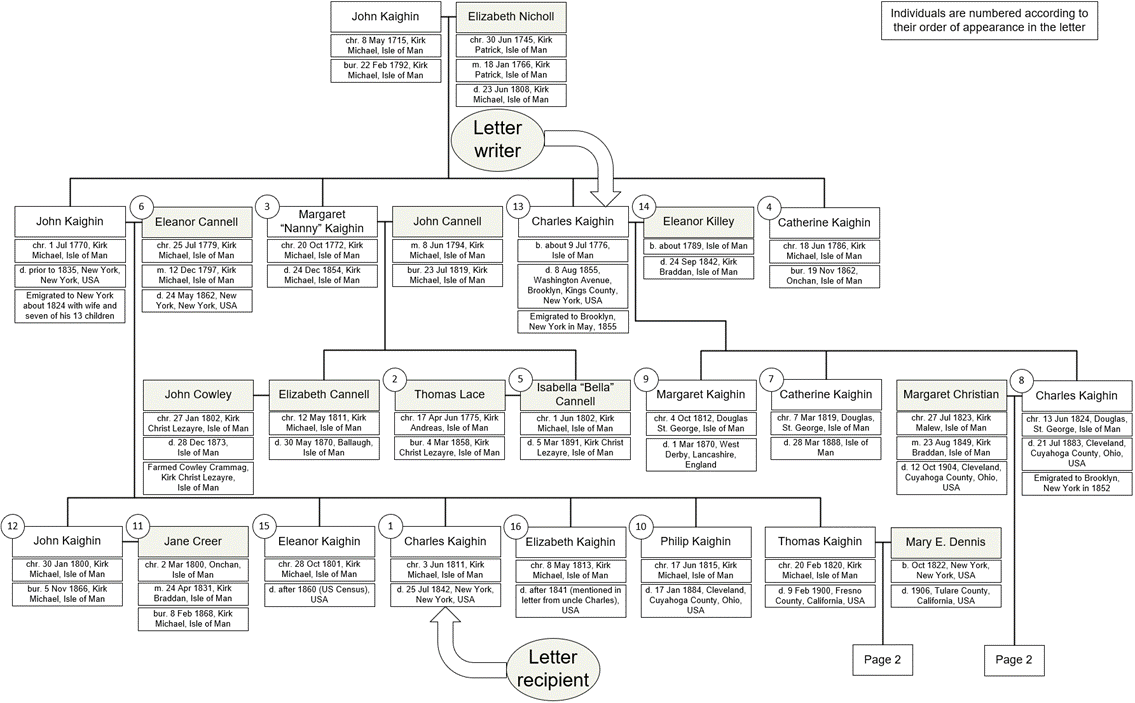
at the bottom of a box and forwarded it to me. The following is a transcription of the letter, with the
original spelling preserved. Bracketed numbers correspond to the numbered
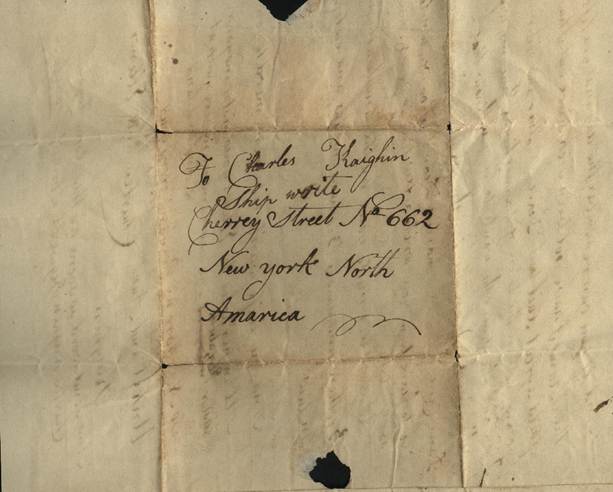
individuals shown in the genealogical chart at the end of this paper. PAGE 1 To Charles Kaighin [1] Ship write Cherrey Street No.
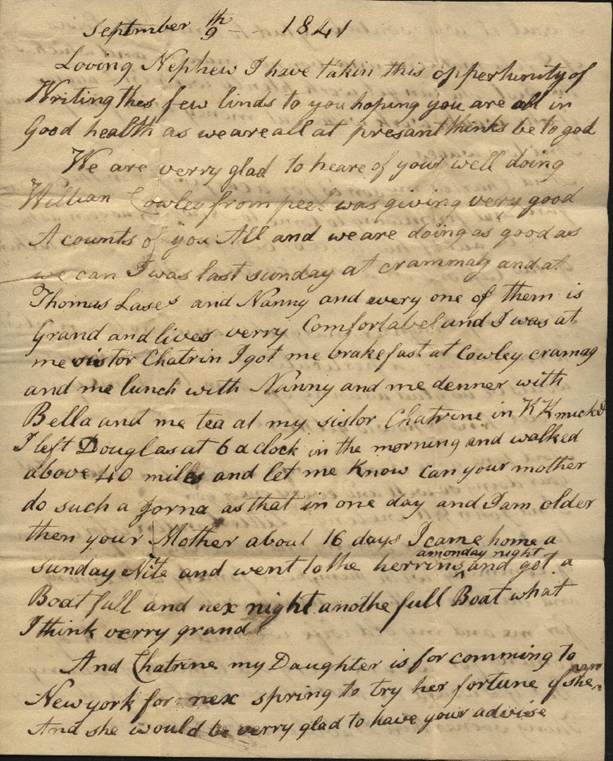
662 New York North Amarica September 9th 1841 PAGE 2 Loving
Nephew [1] I have taken this opportunity of Writing thes few lines to you hoping you are all in good health
as we are all at present thanks be to god. We are
verry glad to heare of your well doing. William Cowley from peel was giving very
good Accounts of you All and we are doing as good as we can. I was last sunday
at crammag and at Thomas Lases [2]
[Lace's] and Nanny [3] and every one of them is Grand and
lives verry comfortabel and I was at me sistor Chatrin [4] I got me brakefast at Cowley cramag and
me lunch with Nanny [3] and me denner
with Bella [5] and me tea at my sistor
Cathrine [4] in KK michael. I left Douglas at 6 a clock in the morning
and walked about 40 miles and let me know can your mother do such a jorna [journey] as that in one day and I am older then your Mother
[6] about 16 days. I came home a Sunday Nite and went to the herrins[?] amonday night and
got a Boat full and nex night another full Boat
what I think verry grand And Chatrine
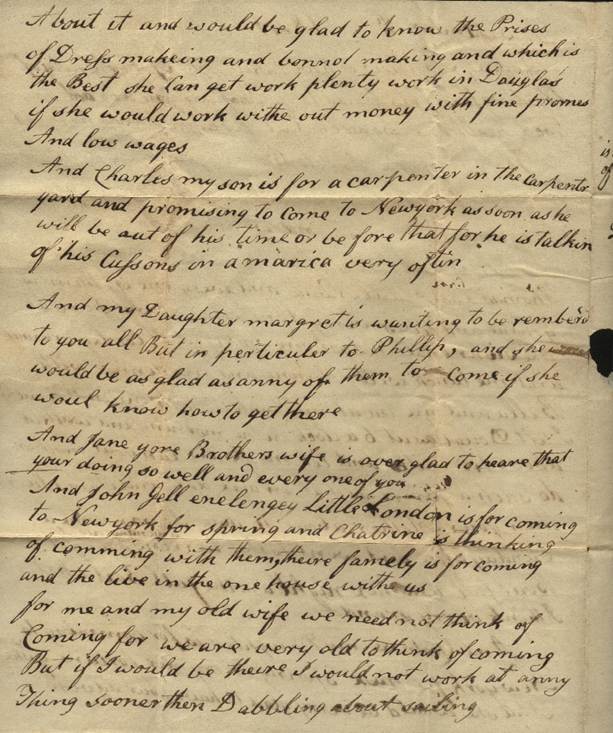
[7] my Daughter is for comming to New york for nex spring to try her fortune if she can. And she would be verry glad to have your advise PAGE 3 About it and would be glad to know the Prices of Dress
making and bonnot making and which is the Best she
can get work plenty work in Douglas if she would work withe out money with
fine promes[promise?] And low wages. And Charles
[8] my son is for a carpenter in the carpenter yard and
promising to come to Newyork as soon as he will be
out of his time or before that for he is talkin of his cussons in amarica very often. And my Daughter margaret [9]
is wanting to be remembered to you all But in perticuler to Phillip [10],
and she would be as glad as anny of them to come if
she would know how to get there. And Jane
[11] yore Brothers [12] wife is over glad to
heare that your doing so
well and every one of you. And John
Gell enelengey Little London is for coming to Newyork for spring and Cathrine [7] is
thinking of comming with them, there famely is for coming and the[y] live in the one house
with us. For me [13]
and my old wife [14] we need not think of coming for we are very old to think of coming. But if I would be there
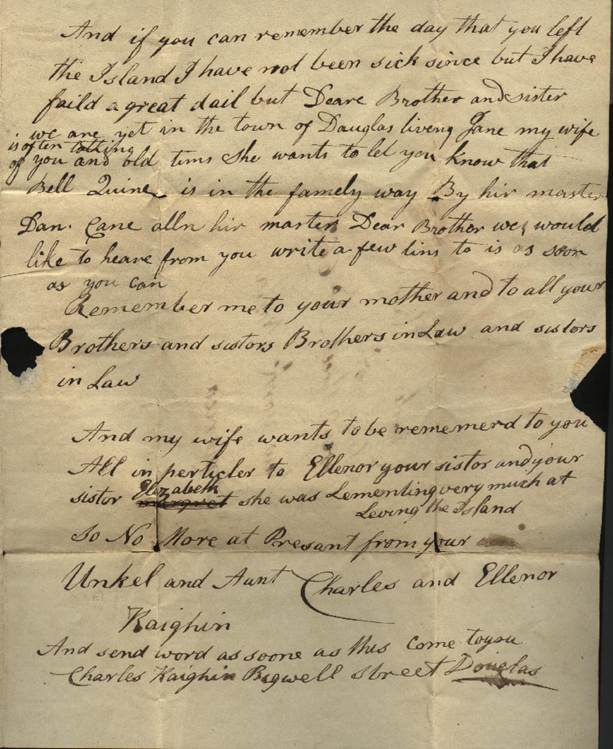
I would not work at anny Thing sooner then Dabbling about sailing PAGE 4 And if
you can remember the day that you left the Island I
have not been sick since but I have faild a great dail but Deare
Brother and Sister we are yet in the town of Douglas living Jane my wife [14]
is often talking of you and old tims. She want to let
you know that Bell Quine is in the famely way. By hir master Dan. Cane alln[?]
hir master. Dear Brother we would like
to heare from you.
write a few lins to is [us] as soon as you
can. Remember
me to your mother [6] and to all your Brothers
and sistors Brothers in Law and sistors
in Law And my
wife wants to be rememerd to you All in perticler to Ellenor [15] your sistor and your sistor Elizabeth
[16] she was Lementing very much at leving the Island. So No More at Presant from your
Unkel and Aunt Charles [13] and Ellenor [14]
Kaighin And send
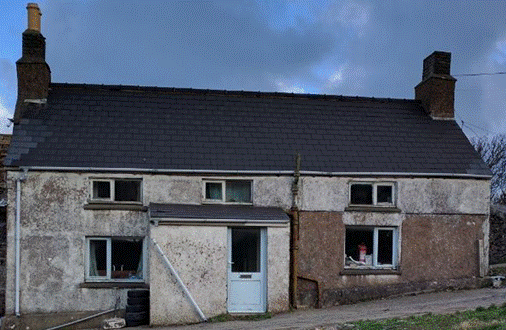
word as soon as this come to you. Charles Kaighin Bigwell Street Douglas End The letter writer, Charles Kaighin, was a son of John Kaighin and Elizabeth Nicholl, whose surname appears in the records under several variant spellings, including Knickol, Crigal, and Knickal. The letter’s recipient, also Charles Kaighin, was a son of John Kaighin and Eleanor Cannell. Eleanor was sixteen days older than the elder Charles. Her husband John, Charles’s brother and likewise a son of John Kaighin Sr. and Elizabeth Nicholl, had died before 1835. John Sr.’s great-great-grandfather acquired Ballaquine before 1619. Middle Kerrowglass had entered the family through his wife Eleanor Cannell’s father, who conveyed the property to her by inheritance in 1614. The cottage at Ballaquine survived until 2016, when it was demolished by the current owners; the cottage and farm buildings at Middle Kerrowglass remain in use as of 2026.
Ballaquine cottage,
2016 John Kaighin and Elizabeth Nicholl represented the fifth
generation of Kaighin tenant landholders associated with the adjoining
quarterland farms of Ballaquine and Middle Kerrowglass. They had eight
children, six of whom survived to adulthood,
including the brothers John and Charles discussed above. Charles married Eleanor Killey in 1807. Of their nine
children, only three, Margaret, Catherine, and Charles Jr., survived to adulthood. Eleanor was still living when Charles wrote
the letter in September 1841, but she died a little more than a year later. Margaret later married William Kneal and moved to
Liverpool, where she died in 1870. Catherine remained on the Isle of Man,
married Robert Roberts, and died there in 1888. Charles Jr. married Margaret
Christian in Douglas in 1848. In 1850, the couple moved to Birkenhead, where
Charles worked as a carpenter at the Cammell Laird
shipyard. They emigrated to Brooklyn in 1852, and Charles subsequently worked
at the Brooklyn Navy Yard. In March 1855, Charles Sr. followed his son’s family to
New York. He died of dysentery in May of that year and was buried in The
Evergreens Cemetery in Brooklyn. By about 1867, Charles Jr., Margaret, and
their five surviving children had relocated to Cleveland, Ohio, probably in
response to the post–Civil War reduction in work at the Brooklyn Navy Yard.
Cleveland’s substantial shipbuilding industry offered suitable employment, and
Charles eventually worked for American Ship Building. Two of his nephews,
William and Philip, the brothers of the letter’s recipient, had also moved to
Cleveland in the intervening years. In addition, several members of Margaret
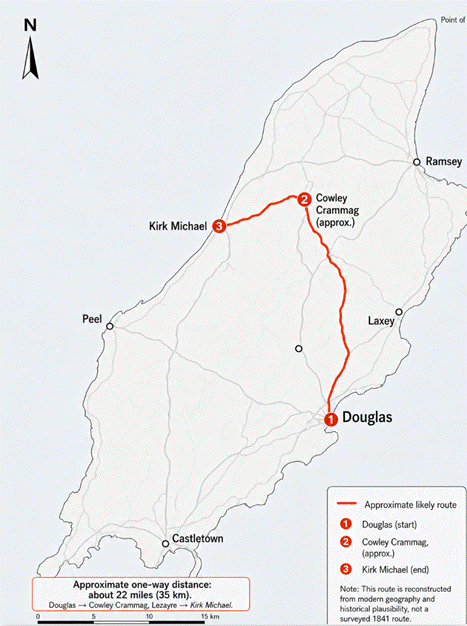
Christian’s extended family were already living there by 1867. In the letter, Charles recounts walking from Douglas to
Kirk Michael, with a stop at Cowley Crammag, where his niece Elizabeth Cowley
als Cannell lived. Elizabeth was a daughter of his
sister Margaret. The map below presents an estimated reconstruction of his
route. |
|
|
|
The
reconstructed one-way distance is approximately twenty-two miles rather than
the forty miles claimed in the letter. The discrepancy may reflect some
measure of exaggeration, perhaps intended to assure his sister-in-law that he
remained vigorous and in good health. Charles operated
a small shipbuilding business in Douglas. His references to herring fishing
and to his wish to “dabble about sailing” if he reached New York are
therefore consistent with his occupation and maritime experience. So far as the
available evidence indicates, neither Margaret nor Catherine emigrated to the
United States. Margaret died in England, and Catherine died on the Isle of
Man. The “Jane”
identified as “yore Brothers wife” was Jane Kaighin als Creer, the wife of
John Kaighin, who had remained on the Isle of Man. Several
individuals and expressions in the letter remain unidentified or unresolved.
I have not determined the identities of William Cowley, Bell Quine, Bell’s
“master” Dan’l Caine, or John Gell of, or associated with, “enelengey Little London.” Little London is a small
settlement approximately three miles southeast of Ballaquine. The meaning of
“enelengey” remains uncertain; it may have been a
sobriquet, or the name of a property. A final textual
ambiguity occurs in the passage, “…we are yet in the town of Douglas living
Jane my wife is often talking….” Charles’s wife was named Eleanor, not Jane.
The wording may therefore represent a simple error, or “Jane” may belong to a
run-on sentence whose intended punctuation and meaning are no longer clear. The letter
offers a valuable, personal view of family life on both sides of the Atlantic
in 1841. It records the continued ties between relatives on the Isle of Man
and in New York, while also revealing the economic hopes, occupational
considerations, and family connections that encouraged further migration.
Charles and, later, his son and his son’s family ultimately crossed the
Atlantic, helping to establish the American branch of the family that
continues today. Greg Kaighin, 2
August 2026 |
|
|
|
|
|
|
Submissions, corrections or suggestions gratefully received by the editor at kaighin@iname.com Copyright 2004-2026, Gregory D. Kaighin, All rights reserved |
